

PPF Installation Checklist: What to Inspect Before Handover in Al Ain
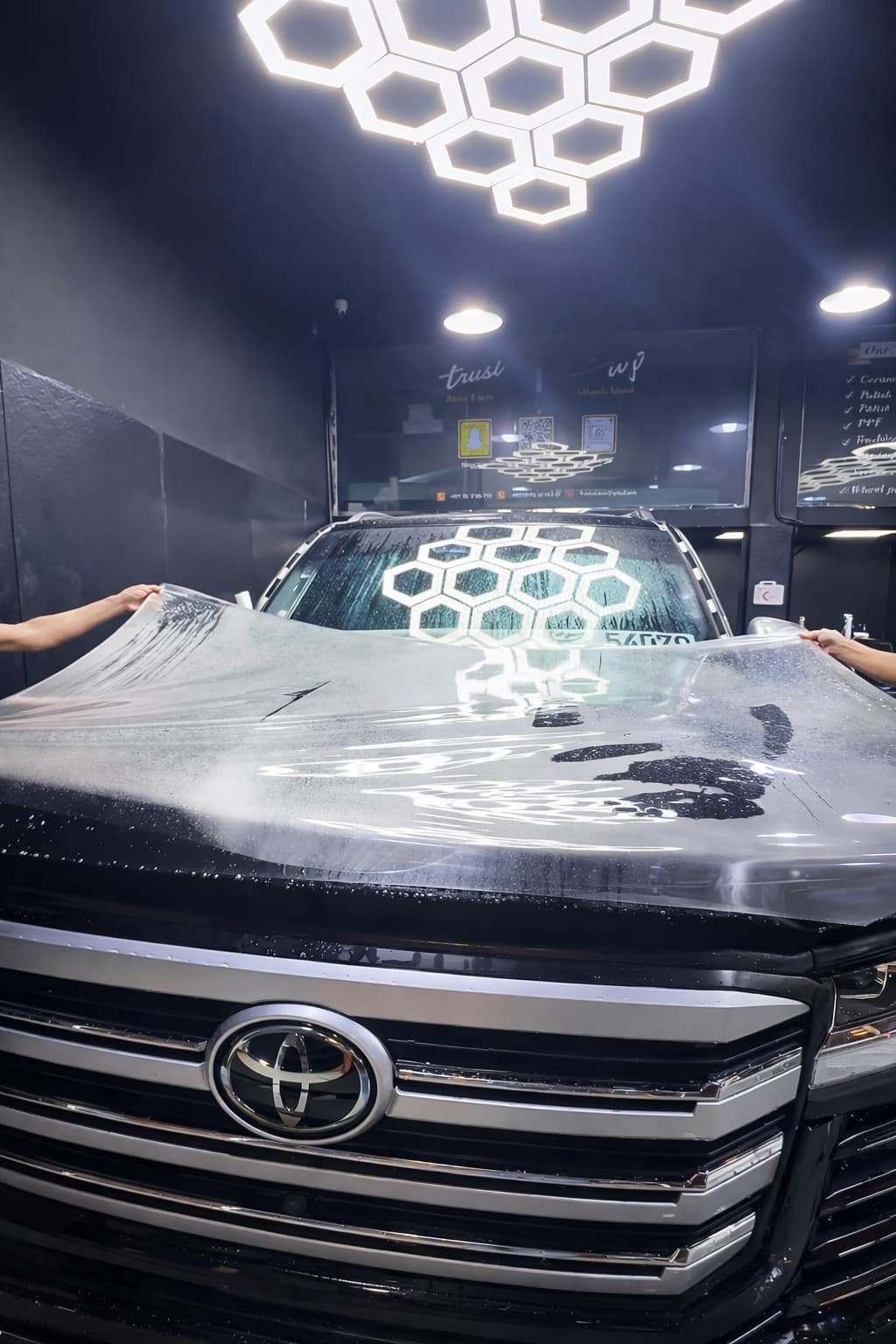
Key takeaways
- Compare the finished coverage with the written quote; partial, full-front, and full-body packages are not interchangeable.
- Inspect in even indoor light and daylight where possible, looking across each panel rather than only straight at it.
- Do not judge every small moisture mark immediately, but photograph it and ask what the installed film manufacturer allows during curing.
- Treat lifting edges, loose film, embedded hair or grit, creases, and unexplained cuts as review items.
- Aftercare timing differs by product. Follow the written instructions for the film actually installed.
- PPF protects paint from some impact and abrasion; it does not repair chips, scratches, or poor repainting underneath.
What a PPF handover inspection is meant to prove
A handover inspection checks whether the promised coverage was installed cleanly, securely, and without obvious damage. It cannot prove how the film will age, and it is not a substitute for the manufacturer’s warranty or a later follow-up inspection.
Paint Protection Film (PPF) is a clear protective film applied over painted panels as a sacrificial layer. The installation result depends on the condition and preparation of the paint, the application method, the environment, and the film itself. 3M’s installation guidance specifically calls for surface cleaning, decontamination, a final pre-installation inspection, and a final film inspection.[3M — Paint Protection Film Installation Guidelines, Revision C]
Trust Auto Care’s published PPF process begins with paint inspection, a safe wash, decontamination, and preparation, followed by installation and a final quality check. Those stages give the owner a sensible handover trail: starting condition, agreed coverage, finished condition, and aftercare.[Trust Auto Care — PPF service process in Al Ain]
The three-stage PPF handover framework
| Stage | Check | Why it matters |
|---|---|---|
| 1. Confirm the job | Vehicle, covered panels, finish, film name, and any excluded areas match the quote. | A neat installation can still be the wrong coverage. |
| 2. Inspect the finish | Review clarity, contamination, edges, seams, corners, sensors, badges, and paint condition. | This identifies visible workmanship or damage concerns before departure. |
| 3. Confirm aftercare | Receive wash timing, care method, follow-up process, invoice, and applicable warranty terms. | Product-specific care affects adhesion, appearance, and any future claim. |
Before leaving the studio
- 1Walk around the vehicle with the installer and the original coverage quote.
- 2Use clean, even light; inspect from straight on and at a shallow angle.
- 3Check the bonnet, bumper, wings, mirrors, pillars, roof edge, door cups, sills, and luggage edge only where they were included.
- 4Photograph any item the installer says should settle, then record the agreed review date.
- 5Confirm whether visible seams or exposed edges are part of the selected pattern.
- 6Ask for the installed film name and the written care and warranty documents that apply to it.
Accept, document, or ask for rework?
XPEL states that many bubbles formed during application can settle as the film and adhesive cure. That is manufacturer guidance for its products, not permission to ignore contamination, creases, or lift on an unidentified film. Ask the installer to distinguish moisture from a solid inclusion and to write down the expected next step.[XPEL — Paint protection film FAQs]
3M instructs customers to inspect the vehicle after film installation and return it to the installer if lifting or peeling occurs. Loose film is therefore a functional concern, not simply a cosmetic preference.[3M — Paint Protection Film Installation Guidelines, Revision C]
| Observation | Practical response | Reason |
|---|---|---|
| Uniform, clear film with secure edges | Accept after confirming coverage and paperwork. | The visible finish matches the basic handover standard. |
| Small moisture marks immediately after installation | Document and ask for the product-specific settling guidance. | Some application moisture can change as the adhesive cures; the acceptable appearance and timing are product-specific. |
| Embedded hair, grit, or a hard particle | Ask the installer to inspect it before handover. | A solid contaminant will not evaporate like installation moisture. |
| Lifted edge, loose corner, or film that moves | Request correction before normal driving. | Film manufacturers advise owners to return to the installer when lifting or peeling occurs. |
| Unexpected seam, gap, or uncovered panel | Compare it with the signed coverage plan. | The question is whether the delivered coverage matches the agreement, not whether every edge is hidden. |
| Cut, scoring line, paint chip, or trim damage not recorded before work | Stop the handover and document the area with the installer. | The underlying vehicle condition needs a clear record before any repair decision. |
Coverage and edge finishing: judge the agreement, not a myth
Not every PPF edge can or should be wrapped on every panel. Vehicle geometry, trim, sensors, badges, panel access, the chosen pattern, and the purchased coverage all affect where film ends. The correct test is whether the installer explained and delivered the agreed pattern cleanly.
Ask where seams and exposed edges will be before installation, especially around complex bumpers, mirrors, parking sensors, grilles, and badges. At handover, look for consistent alignment and secure finishing. A visible edge may be acceptable when disclosed; a jagged, lifting, or unexpectedly placed edge needs discussion.
Partial coverage can also create deliberate film lines. Do not treat a full-front package as full-body coverage, or assume a quoted bonnet and bumper package includes wings, mirrors, pillars, roof edge, door cups, or sills. Trust Auto Care publishes front-end, partial, and full-body discussions as part of its assessment process.[Trust Auto Care — PPF service process in Al Ain]
Inspect the paint and previously repaired panels
PPF follows the surface underneath it. It may reduce the visibility of some fine marks, but it does not repair chips, deep scratches, failing clear coat, or poor repainting. Existing damage and previous repairs should be recorded before installation.
3M identifies OEM painted surfaces as the standard substrate for the products in its guide and calls for an adhesive-bond check on some other paint types. This does not mean every repainted panel is unsuitable; it means repaint history should be disclosed and assessed rather than assumed.[3M — Paint Protection Film Installation Guidelines, Revision C]
If a panel has been repainted, ask how that affects installation, removal risk, and any warranty. Do not accept a blanket promise that every future removal will be harmless. Paint condition, repair quality, preparation, film, age, and removal method can all matter.
Aftercare in Al Ain and Abu Dhabi: follow the installed product
Keep the written aftercare for the exact film installed. Do not wash early, direct pressure at film edges, scrub with abrasive tools, or let unknown chemicals sit on the surface. If an edge lifts, stop aggressive cleaning and contact the installer.
Manufacturer instructions are not identical. The current 3M guide says to wait at least 72 hours before washing, while XPEL’s ULTIMATE PLUS care page says 48 hours. The safe conclusion is not to choose one number for every film; follow the written instructions for your installed product and installation.[3M — Paint Protection Film Installation Guidelines, Revision C][XPEL — Product care instructions]
3M recommends hand washing or touchless washing, neutral shampoo, shaded washing, quick drying, and careful pressure-washer technique that does not force water under an edge. Those are 3M product instructions, but the underlying questions are useful for any handover: what shampoo, what wash method, how long to wait, and what to do if an edge changes.[3M — Paint Protection Film Installation Guidelines, Revision C]
The UAE government describes the country’s climate as arid and prone to dust and sandstorms. For Al Ain and Abu Dhabi owners, that makes dry wiping a poor response to a dusty car: loose particles should be removed with a film-compatible wash method rather than rubbed across the surface.[UAE Ministry of Climate Change and Environment — National Adaptation Plan Roadmap]
When PPF may not be the right next step
Delay installation when paint or repaint condition is uncertain, when an active repair is needed, when the owner cannot confirm what coverage is being purchased, or when aftercare requirements are unrealistic. A simpler protection package may also be better value if the car has extensive existing paint damage or will be kept only briefly.
Trust Auto Care prices protection work by vehicle and selected service rather than publishing a fixed universal amount. Send the make, model, model year, paint condition, desired coverage, and clear photographs for a relevant quotation.[Trust Auto Care — vehicle-specific protection packages]
PPF handover questions
Are bubbles normal immediately after PPF installation?
Some moisture-related marks can settle during product-specific curing, but embedded dirt, hard particles, creases, or lifting should be inspected. Photograph the area and ask the installer to identify it and record the follow-up plan.
How soon can I wash a newly PPF-covered car?
Use the written instructions for the installed film. Manufacturer guidance differs: the cited 3M guide says at least 72 hours, while XPEL’s cited care page says 48 hours for ULTIMATE PLUS. Do not apply one brand’s timing to an unidentified product.
Should every PPF edge be wrapped and invisible?
No. Panel geometry, access, sensors, trim, badges, pattern choice, and purchased coverage affect edge placement. The installer should disclose the planned finish, and the completed work should match it cleanly.
Can PPF hide existing stone chips or scratches?
PPF does not repair paint. Some fine marks may look less obvious under film, but chips, deep scratches, failing clear coat, and repaint defects remain underneath and should be documented first.
What should I send for a PPF assessment and quote?
Send the make and model, model year, current paint condition, previous repaint information, desired coverage, and clear photographs of the front, sides, and any damaged areas.
Sources and verification notes
Manufacturer references describe their own products and do not establish that Trust Auto Care supplies, installs, or is authorised by those brands. Always use the documents for the film named on your invoice.
- Trust Auto Care — PPF service process in Al AinAccessed 2026-07-24
- 3M — Paint Protection Film Installation Guidelines, Revision CAccessed 2026-07-24
- XPEL — Paint protection film FAQsAccessed 2026-07-24
- XPEL — Product care instructionsAccessed 2026-07-24
- UAE Ministry of Climate Change and Environment — National Adaptation Plan RoadmapAccessed 2026-07-24
- Trust Auto Care — vehicle-specific protection packagesAccessed 2026-07-24
Plan and care for your PPF
Ask for a PPF coverage and paint assessment
Send your car’s make and model, model year, current paint condition, preferred coverage, and clear photographs. Trust Auto Care can then advise whether PPF is suitable and prepare a vehicle-specific quote.
Ask about PPF on WhatsApp